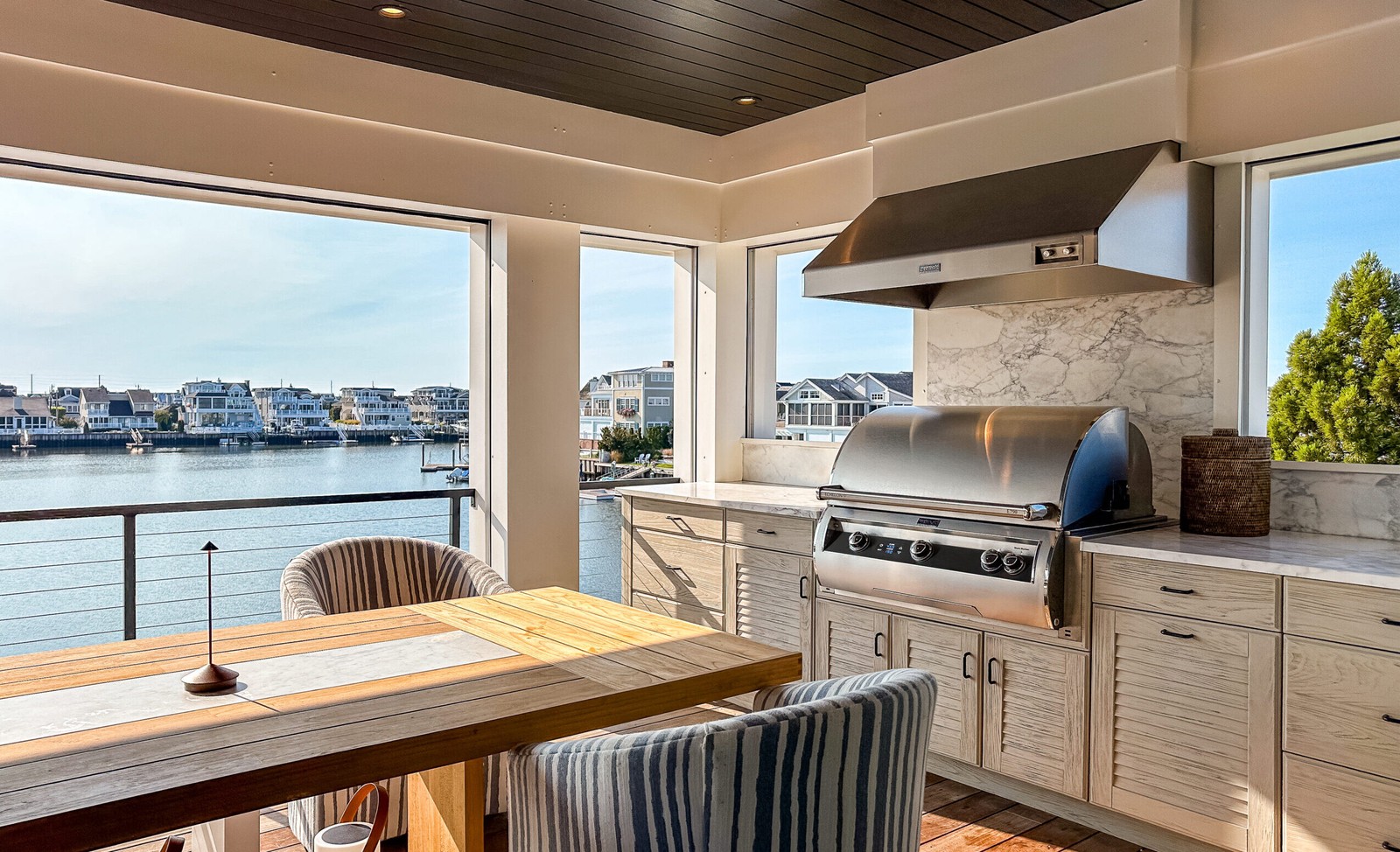
A grill under a lanai.
A grill under a lanai can work only when the appliance manual, the roof and wall materials, ventilation, fuel arrangement, and local decision makers all agree. Built-in gas grills publish different clearances, and a screen cage does not remove heat or smoke. Start with the exact model and a site measurement.
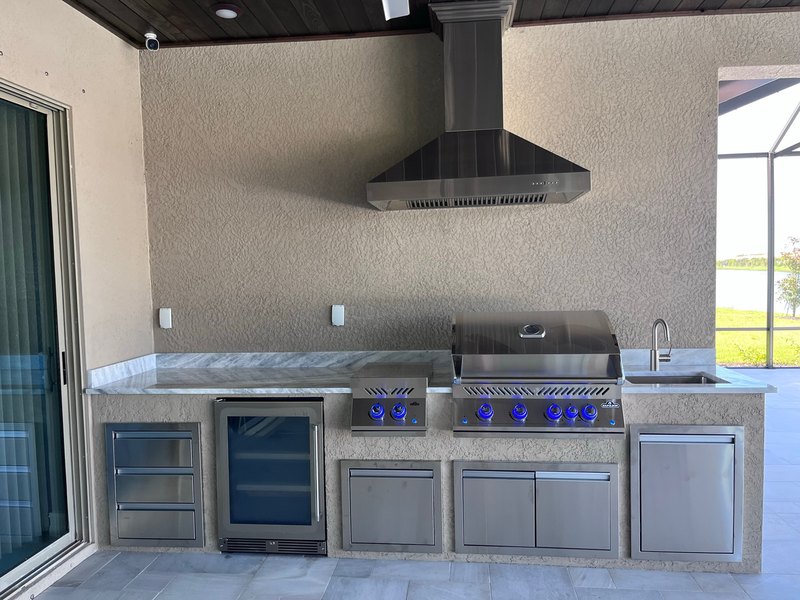
Can I put a grill under my lanai or pool cage?
It depends on the exact model. A grill can go under a lanai or pool cage only when the manual's clearances to the roof and walls are met, the ventilation plan works, and the permit and structural checks pass at your address. Start with the manual, then measure the site.
A lanai is not one construction type. The roof may be concrete, painted wood, or another material. The posts may be aluminum. The cage may have screen mesh on every side. The grill may be built-in gas, freestanding charcoal, or a pellet cooker with electronics. Those details change the answer.
The first document is the appliance manual. The second question is what sits above and beside the heat. The third is how smoke leaves the space. A pool cage feels open when you stand in it, but smoke still travels into the mesh, roof soffit, furniture, and the house wall.
| Start with | Exact grill model and its manual |
|---|---|
| Check next | Combustible material, roof, walls, and screen cage |
| Plan early | Vent hood, gas route, power, and service access |
What clearances and ventilation does a built-in gas grill need?
Follow the clearance table in the US installation manual for your exact grill model before planning the opening. We'll go through it with you. Ask the manufacturer whether a solid roof is allowed for that model.
Twin Eagles Gas Grill Installation, Use and Care Manual (PDF) says the minimum clearance is 12 inches from the back and sides to adjacent combustible construction. It also says the appliance "shall not be located under overhead-unprotected combustible constructions." Its noncombustible clearance is 2.5 inches at the back above the cooking surface so the hood can open, with 6 inches at the sides recommended.
Delta Heat's Installation, Use, & Care Manual (PDF) uses 12 inches at the back and sides to adjacent combustible construction and says not to locate the appliance under overhead unprotected combustible construction. Its diagram calls for 3 inches behind the hood to allow it to fully open. Follow the manual for the model you buy.
When does a covered kitchen need a vent hood?
Twin Eagles says a quality vent hood is essential when a kitchen is under a roof or pergola to remove smoke and grease. Its hood page lists 36 inch, 48 inch, and 60 inch sizes, three-speed control, stainless baffle filters, and a blower motor sold separately.
Zephyr's outdoor hood guidance says a powerful range hood is necessary and often required by building codes when an outdoor grill is under a combustible covered structure. Its Spruce insert page lists a 1,200 CFM blower, a measure of airflow, for wall or island use. Your contractor plans the hood size, duct route, where exhaust leaves and how fresh air gets in.
What happens to screens, smoke, and heat?
Keep grills and smokers well away from screens and the roof edge. Screen frames, mesh, furniture and paint can be damaged by heat. Check the grill manual and ask your contractor about placement.
Charcoal and pellet smoke remain inside a cage until wind or mechanical ventilation moves them out. During a long Meadow Creek cook, we normally want the smoker away from the screened sitting area rather than under the cage. A built-in gas grill with a properly planned hood is a different layout question. Visit our smokers and grills catalog before you draw the island.
How should natural gas and propane be handled?
Natural gas removes the portable cylinder from the layout, but it still needs a correctly sized line, accessible shutoff, leak test, and work by the licensed contractor. Propane tank placement under a roof is subject to NFPA rules (PDF) and local code. Ask your licensed contractor and building department before placing a tank.
The grill manuals add appliance-specific cylinder rules. Twin Eagles says an LP cylinder enclosure needs upper and lower exterior ventilation, and gives ventilation-area requirements based on stored fuel capacity. Delta Heat says not to place more than one cylinder in its enclosure and says not to use a dented or rusted cylinder. Ask your licensed contractor and local building department how the rules apply to your home.
Why do pellet grills need a different plan?
Pellet grills have electrical parts. Keep the controller and outlet dry and follow the grill's instructions for rain and covering. Store pellets indoors in their bags or a waterproof container.
Floor loads and pool deck structure are questions for the licensed contractor and the engineer. We do not give a number for a deck or tell you that a slab can carry a specific cooker. The contractor checks the actual deck, base, access route, and local requirements.
How does Pinecraft plan a lanai kitchen?
An island against the house wall keeps the cooking line close to existing utilities and leaves more open floor in the lanai. A freestanding island can face the pool or seating area, but it needs a deliberate route for gas, power, service access, and smoke. The right drawing depends on the doors, posts, screen panels, and roof above it.
We offer a free in-home measurement. Bring the roof height, screen cage photos, pool deck details, and the model you are considering. We design your outdoor kitchen, supply the equipment and provide the installers. Gas, electrical and plumbing work is performed by appropriately licensed contractors. See outdoor kitchens, review the service area, or rent a cooker before making the permanent choice.
Compare the local pages for Twin Eagles, Delta Heat, Napoleon grills, Big Green Egg, and Meadow Creek. You can also review grill inserts before the opening is drawn.
Who decides what?
Confirm permits and local requirements with the building department that serves your address, whether city or county. The HOA decides its review and setback rules. The licensed contractor and engineer decide floor loads, gas routing, electrical work, wind questions, and the construction details. Use the appliance manual for its clearances and ventilation instructions, then have your contractor check local requirements. Pinecraft supplies the equipment and design information.
Call (941) 217-6995 or visit the Sarasota showroom at 3303 Bahia Vista St, Sarasota, FL 34239. Send permit questions to the building department that serves your address. Send structural questions to the contractor or engineer on your project.
Outdoor kitchen example